
Iran retaliation raises questions about US air defences
Jonathan BealeDefence correspondent
 Getty Images
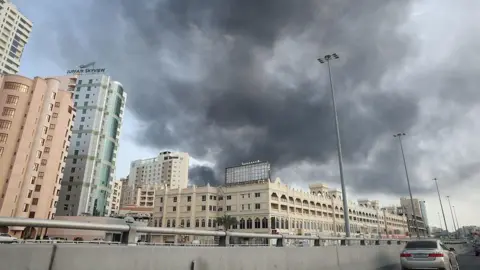
Iran has targeted the US Navy base in Bahrain, highlighting gaps in air defences, which will worry Washington and its allies in the region.
Videos appear to show missiles and drones striking the vicinity of the US Fifth Fleet headquarters in Bahrain.
As yet there are no reports of casualties. The US military will likely have had some warning of the attack and taken precautions to evacuate personnel.
Tom Sharpe, a former Royal Navy Commander, says Bahrain was likely seen by Iran as a high profile target that has, in the past, had relatively little in the way of air defences.
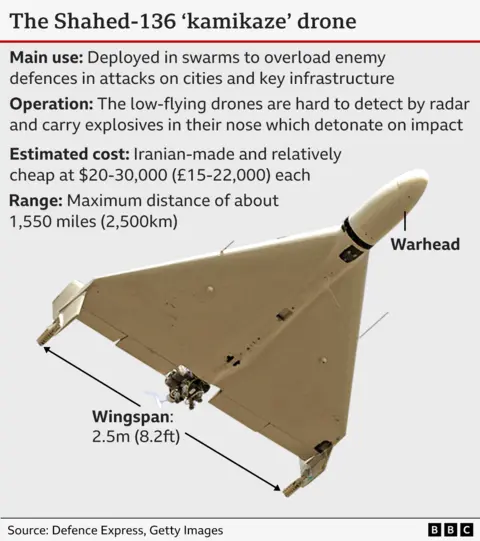
That now appears to have been highlighted by video showing a relatively slow-moving Iranian Shahed drone breaching its defences. In Ukraine such drones can often be shot down with a simple high calibre machine-gun.
Over the past few weeks, the US is reported to have flown out additional air defence systems to the region - including sophisticated THAAD and Patriot Systems - which can shoot down ballistic missiles. But these are expensive and limited in numbers.
For context, Ukraine has fewer than 10 Patriot batteries and still struggles to defend the capital, Kyiv.
It is still unlikely the US has sufficient numbers to protect all its military bases and interests it has in the Middle East.
The US Navy has also deployed around a dozen Arleigh Burke-class Destroyers to the Gulf and the eastern Mediterranean.
These air defence destroyers can also shoot down drones and ballistic missiles.
They have already proven effective in the Red Sea against the Iranian-backed Houthi rebels in Yemen. Between 2024 and 2026, the US intercepted nearly 400 Houthi drones and missiles.
US fighters jets, which have been sent to the region, are also capable of intercepting drones and missiles. The US now has more than 100 jets in the region.
But even these significant capabilities are unlikely to be enough to prevent Iran from successfully striking some targets.
Before these latest US and Israeli strikes, Iran still probably had an arsenal of around 2,000 short-range of ballistic missiles. It has many more one-way attack drones.
Iran's Shahed drone has been exported to Russia and continues to cause havoc across Ukraine. Russia is now producing thousands of these drones a month and has likely given Iran help to advance its technical capabilities.
Sharpe says that during his time in the Royal Navy, they conducted war games simulating an Iranian attack on military basses in the Middle East. In some scenarios missiles and drones would inevitably find their way through limited air defences.
"If the Iranians unleash everything - go hard and fast if the regime feels threatened, then eventually the US will run out of THAAD and Patriot interceptors," he says.
Sharpe also says that Iran's drones and missile capabilities "are massively dispersed".
But Edmund Fitton-Brown, a senior fellow at the Foundation for Defense of Democracies - a US-based research institute focusing on foreign policy - says there may be evidence that the Iranians, while willing to retaliate, may not want to escalate this into a wider conflict.
He says it is still unclear how much the attacks by the US and Israel last year damaged some of Iran's military capabilities.
"The early signs are that the Iranian retaliation has been rather moderate in scope," he adds.
It is worth remembering that after a year of targeting the Houthis in Yemen, the US had damaged but not destroyed its ability to launch missiles and drones.
 Getty Images
Wars fought from the air alone rarely achieve conclusive victories or regime change.
The Nato-led bombing campaign on Libya in 2011 may be a rare exception, though in that case case chaos ensued.
Iran also has significant capabilities to attack the US Navy - if in range. It has large stocks of anti-ship missiles, as well as small, fast, uncrewed attack boats. There is also the unanswered question of whether China may have given Iran military support over the past few months.
Daniel Byman, from the Washington-based Center for Strategic and International Studies, says that early strikes may damage Iran's leadership and military assets, but the US "may struggle to sustain operations while Iran's main path to survival is simply to endure".
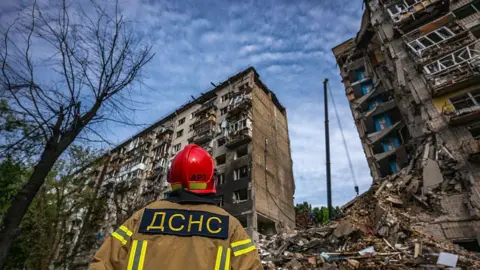
Ukraine is a reminder of the importance of air defences. It continues to be the number one request from President Volodymyr Zelensky to allies.
Ukraine also shows how hard it is to defend against multiple complex attacks involving hundreds of drones and dozens of missiles. The US has more resources and along with Israel will be targeting Iran's drone and missile factories and launch sites.
But eradicating that threat won't be easy. A prolonged conflict will not just be a challenge for Iran, but also for the stocks and supplies of US weapons - in a war far from home.




